
Cheektowaga Past Address Sources
The backward trail begins with the current parcel and moves to the instrument that connects it with a prior party. The Town of Cheektowaga assessment systems supply the address, owner, mailing address, and SBL or parcel clues. Erie County Clerk records supply the deed chronology and legal description. Historical directories and census schedules supply dated household evidence, while permits, inspections, obituaries, probate, and cemetery records can test a transition. Each source has a different time range and purpose. A property record can identify an owner or mailing recipient, but it does not establish every person who lived at the address.
| Source | Years It Covers | Where Held | What It Shows |
|---|---|---|---|
| Erie County deed records | 1808 to present; online index from 1986 | Erie County Clerk BrowserView and Basement Records | Recorded parties, date, book or page, legal and parcel details |
| Deed images | 1960 to present | Registered access, public terminals, or copy request | Instrument image and legal description |
| Erie County Suburban and Buffalo Northeast Suburban directories | 1949 to 1964; 1957 to 1980 | Grosvenor Room | Historical address and name listings |
| County and Buffalo directory volumes | 1870; 1916/17; 1917; Buffalo digital 1832 to 1913 | Grosvenor Room and New York Heritage | Regional household, business, and address leads |
| Federal and New York State census schedules | Federal released schedules; state microfilm 1850 to 1925 | Library, County Clerk, and genealogy databases | Household and location context |
| Permit, code, and I&I materials | No public historical index located | Town Building Department request route | Applicant or owner, address, work, and inspection dates |
Start with the parcel when the address is known. Start with a directory or census when the question is an older household. An address-only request to the Clerk may fail because official records are not indexed by street address. Capture a party name, book and page, instrument number, map number, or parcel ID before moving to the deed index.
Cheektowaga Past Parcel Start
The Cheektowaga BAS parcel search offers address, owner or business, SBL, and general-location modes. The town's PROS Property Search describes assessment information, property inventory, and comparable sales. For a known address, save the owner name, property or situs address, owner mailing address, SBL, map reference, and any visible deed book, page, or file number. The Town says assessment material is updated periodically, so confirm current data with the Assessor if the date matters.
Keep the address fields separate. A situs address identifies the parcel. A mailing address is used for assessment correspondence and may differ from the parcel. The SBL and the legal parcel reference are stronger bridges to older records than a street number alone. If a parcel was split, merged, or renumbered, the historic deed may use a lot, map, or metes-and-bounds description instead of the modern address.
Note: Label each parcel clue as owner, mailing recipient, assessment record, or deed citation rather than calling all of them residence evidence.
Cheektowaga Past Deed Index
The key Erie County date difference is simple but important: deeds are maintained from 1808, the normal online land-record index begins January 1, 1986, and deed images begin January 1, 1960. A no-result in the online index is not proof that no earlier deed exists. For deeds from 1960 through 1985, image work can require the Graves Index or a Liber or book and page path. Older records may require the County Clerk's Basement Records, public terminals, microfilm, or staff assistance.
The Erie County Clerk legacy Official Records search is the source captured for the grantor-grantee and book-page research route.
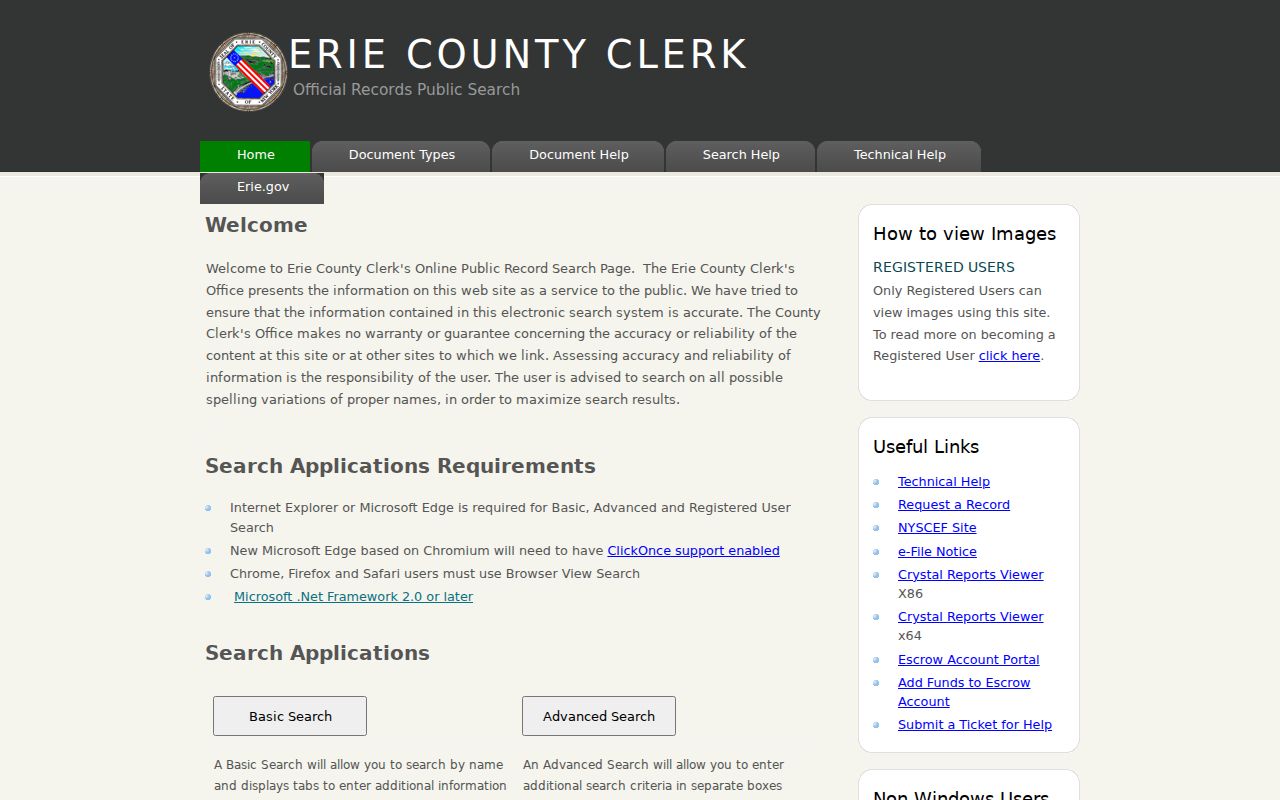
The image illustrates why a historical address trail needs a party or book-page bridge before the Clerk search can continue.
The Clerk's published records coverage also describes mortgages from 1840, naturalizations from 1827 to 1929, and other historical holdings. Those categories can explain a name or legal-interest change, but a deed remains the core chain-of-title record for the address.
Tracing Cheektowaga Previous Owners
Use the deed chain as a transaction chronology, not a household list. In Erie County Clerk BrowserView, the useful criteria include Party Name, Document Type, Instrument Number, Book and Page, Map Number, Parcel ID, legal-description line, and date range. Party-name instructions use last name first name with no comma. The results can show the instrument number, recording date, book or page, consideration, map or parcel, legal lines, direct and indirect parties, notes, and linked documents. Image access may be restricted or require login.
- Search the address in BAS or PROS and record the current owner, SBL, deed book and page, file number, and available legal description.
- Use the owner, book and page, instrument number, or parcel identifier in BrowserView to locate the latest deed.
- Record both parties, the recording date, legal description, parcel or map reference, consideration, and linked-document details.
- Treat the current grantor or seller as a prior grantee, then search that name in an earlier date range for the preceding purchase.
- Repeat the process while comparing legal description, map, parcel, lot, or subdivision continuity at every transfer.
- When the online path reaches its cutoff, ask whether the record is in the Graves Index, a deed book, microfilm, or an electronic image at the Clerk's counter.
The recording date can differ from a closing date. A mortgage, assignment, satisfaction, lien, or lis pendens may supply an event date without showing a new resident. Preserve the direct and indirect party labels rather than copying only the first familiar name.
- Grantor and grantee
- The grantor conveys an interest in a recorded instrument; the grantee receives it. In a backward deed search, the later grantor can lead to an earlier grantee entry.
- Chain of title
- The ordered sequence of recorded conveyances and related instruments that connects an earlier interest with a later parcel.
- Legal description
- The lot, map, parcel, or metes-and-bounds wording in the document. It can maintain continuity when street numbering changes.
- Graves Index
- A historical Clerk research path used with Liber or book and page information for older image retrieval.
Cheektowaga Past Records Route
For the oldest address histories, the counter is not a last resort. The County Clerk's general rules direct requesters to Basement Records and public computers for document images that may not be available through remote indexing. Mail and in-person requests go to Erie County Clerk, 92 Franklin Street, Buffalo, NY 14202. The document request form asks for a name, approximate filing date, municipality, address, book and page, index or file number, document type, and whether certification is wanted. Missing book, page, or index information can create search charges, and certified copies cannot be emailed.
Use the parcel work to make the request specific. The county states manual staff searches cost $10 per name per two-year period and digital searches cost $5 per name per two-year period. Ask staff which historical format applies before paying for a broad name search. A request can also include a self-addressed, postage-paid envelope and payment. Keep the returned citation in the evidence table so the next deed can be searched by the same record key.
Cheektowaga Past Household Trail
Recorded ownership is only one layer. To investigate who lived here before, pair a nearby directory year with the relevant census schedule. The Cheektowaga city directory collections explain the shelf and digital runs in depth; for an address trail, use those runs to log the listed name, initials, occupation or business, and exact address. Then compare the date with a federal or New York State census. Erie County state-census microfilm lists 1850, 1855, 1860, 1865, 1870, 1875, 1880, 1892, 1905, 1915, and 1925 and is organized by ward, election district, block, street, and house number.
- Choose the closest available directory year and transcribe the printed line exactly.
- Check a year before and after for a surname, initials, address, or business change.
- Locate the applicable federal or state census by the recorded ward, district, block, street, and house number.
- Compare the directory and census names, then test a transition with a deed, tax record, obituary, church record, school yearbook, or permit.
- Record a gap as a gap. A directory disappearance can mean a move, omission, business change, parcel change, or a different indexing choice.
Directories may list a head of household, boarder, business contact, or mail recipient. A census also reflects its own enumeration date. Neither source should be forced to match a transfer date without the deed and legal-description trail.
Cheektowaga Past Atlas Clues
The 1953/1955 Town of Cheektowaga Historical Atlas is a useful local bridge when an old address needs neighborhood context. Julia Boyer Reinstein, town historian from 1953 to 1992, compiled the atlas after Town Board authorization. Its maps, Western New York material, and early Native-territory map can help distinguish historical road or place-name context from a modern parcel screen. The atlas does not replace a deed or a survey, but it can explain why an older citation uses a different local label.
The Anna Reinstein Memorial Library keeps selected family records, documents, and printed material in its appointment-only Reinstein Family Archives, with material from roughly 1805 to 1998. The Grosvenor Room remains the main directory, obituary, article, map, and census research room. Together, those institutions supply historical context when the formal deed chain reaches a local road, railroad, parish, or subdivision name.
Cheektowaga Past Address Dates
Town Building Department material can add a date clue between deeds and directory years. Forms can capture an applicant or owner, legal installation address, owner address, closing date, property type, permit or inspection number, and observations. The research found no public, indexed historical permit database. For a particular property, request the permit or inspection record from the clerk, identify the address and date span, or submit a reasonably described New York FOIL request.
Code, permit, and I&I materials document an application, inspection, work item, or reported issue. They do not prove who lived at the address. Their strongest use is to date an alteration, transfer-related inspection, or parcel event beside the deed sequence. When a map shows a boundary change, compare the map, recorded plat, and legal description before tying the record to a modern street number.
Note: Put permit and inspection dates beside recording dates, never in place of them, because the two records describe different events.
Cheektowaga Past Trail Endpoints
Obituaries, probate, cemetery requests, church records, and newspapers can help close a past-residents trail after a person leaves the directory or deed chain. B&ECPL's local-history resources include newspaper files, church and cemetery material, yearbooks, and obituary lookups within service limits. Search newspapers by surname, street, parish, school, or community association. Request burial records from the cemetery because they are separate from vital records. A complete Cheektowaga obituary-year index was not located in the reviewed official sources.
New York genealogy access also has date and eligibility rules. The state generally opens birth genealogy records after 75 years if death is known, death records after 50 years, and marriage records after 50 years when both spouses are known deceased. The New York State genealogy guidance explains those limits. An endpoint may confirm a death or family connection, but it should not be used to fill an unproven address gap.
Cheektowaga Past Address Limits
The address trail stops at public-record boundaries. It can connect a parcel with recorded parties and historical listings, but it cannot establish every person who was present in a building. It also cannot overcome protected addresses, restricted vital records, or confidential voter procedures. Postal city, ZIP, village, and tax jurisdiction can differ around Sloan, Depew, and Buffalo edges, so retain separate fields for situs municipality, postal city, ZIP, tax jurisdiction, village, and county.
End every chronology with the source, date, citation, evidence type, and a note about what remains uncertain. That record of limits makes the history more useful than an unsupported list of names.