
Cheektowaga Directory Collections
Cheektowaga was suburban and rural territory for much of its record history, so the useful directory shelf is not one uniform town series. The Buffalo & Erie County Public Library holdings guide points researchers to county, suburban, Buffalo Northeast Suburban, and Buffalo volumes that include the town or its surrounding communities. Search the catalog for the year in question before assuming a gap. The 1870 register is especially useful for rural names, farmers, and businesses. Later suburban volumes better fit postwar expansion and the Sloan and Depew edges. A directory result is a dated listing, not a complete resident roll.
| Collection | Years | Where Held | Access |
|---|---|---|---|
| Buffalo Erie County Register and Business Directory | 1870 | Grosvenor Room cataloged bound volume | Onsite reference |
| Erie County directory | 1916/17 and 1917 | Grosvenor Room | Onsite |
| Erie County Suburban business directories | 1949 to 1964 | Grosvenor Room | Onsite |
| Buffalo Northeast Suburban | 1957 to 1980 | Grosvenor Room | Onsite |
| Buffalo Suburban | 1983 to present | Grosvenor Room and library catalog | Onsite, current holdings |
| Buffalo City directories | 1828 to present; digital run 1832 to 1913 | Grosvenor Room and New York Heritage | Onsite and digital |
| HeritageQuest directories | Buffalo 1861 to 1960; local coverage varies | Library database | Library-card access |
| Reinstein Family Archives | 1805 to 1998 | Anna Reinstein Memorial Library | Appointment |
The exact bound-volume gaps for every Cheektowaga year were not located in the official materials. A missing standalone town title should lead to the Erie County, suburban, and Buffalo Northeast Suburban series before ending the search. The guide also notes social registers and directories beyond Buffalo and Erie County, which can help when a family crossed a municipal or postal boundary.
Cheektowaga Directory Research Room
The Grosvenor Room at the Central Library, 1 Lafayette Square in Buffalo, is the main human research stop for a Cheektowaga historical-directory question. Its noncirculating collection includes directories, maps, newspapers, yearbooks, church and cemetery material, microfilmed Erie County records, and a local-history file. The room also holds complete Buffalo directories from 1828 forward and directories for other places. Visitors sign in, place bags in lockers, and use materials in the room. That access model matters when a volume has no online scan or a catalog record gives only a broad series title.
Library staff offer free obituary, directory, and article lookups within their service limits. A concise request with the surname, likely address, approximate year, and variant spellings gives staff a usable target. The reference desk does not promise to reconstruct an entire family. HeritageQuest may be used from home with a valid library card, while Ancestry Library Edition and some FamilySearch images may require in-library or affiliate-library use.
Note: Record the volume title and page with every transcription so a later reader can distinguish a printed listing from an index result.
Cheektowaga Directory Digitization
The digitized Buffalo directory collection is a regional bridge, not a modern address database. New York Heritage's Buffalo City Directories collection covers 1832 to 1913 and holds 77 digitized volumes from B&ECPL. Browse a volume or use OCR with care, then compare a possible hit against the page image. The regional scope helps when an older Cheektowaga person appears in Buffalo-connected commercial, church, or family records.
The New York Heritage collection page documents the digitized Buffalo directory volumes used as a regional companion for Cheektowaga research.
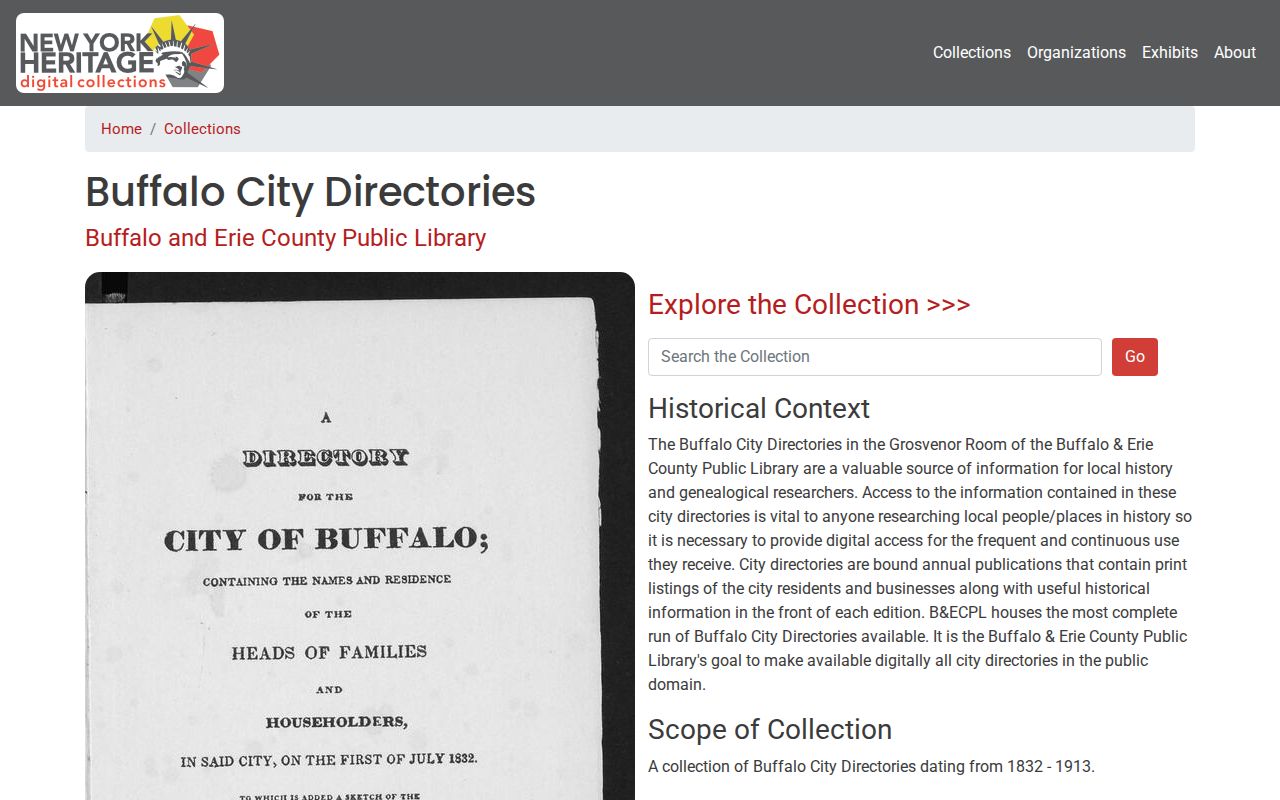
The online collection helps identify a volume and page, while the Grosvenor Room catalog remains the authority for Cheektowaga-area holdings and later suburban runs.
A scanned 1893 Buffalo City Directory item shows the limit of a digitized page. Its metadata identifies the title, original date, subject, holding institution, collection, format, identifier, and rights. The printed page is still the source to read. It does not create a dependable structured field for a spouse or date of birth.
Reading Cheektowaga Directory Entries
Read an entry exactly as the volume presents it. In the inspected 1893 scan, the alphabetical name section, street or address line, and occupation or business line are the core transcription targets. A printed directory can also vary its spouse, family, or lodging notation by year. The front matter and abbreviation key for that particular volume are part of the evidence. Do not expand a mark from memory, and do not assume that an address line proves ownership or that a missing person was absent from the household.
| Name | Transcribe the spelling, initials, and order used in the alphabetical section. |
|---|---|
| Occupation or business | Copy the printed wording; it can separate people with the same name. |
| Address line | Capture the street and number exactly, then compare it with the volume's own conventions. |
| Spouse, family, or lodging detail | These details vary by volume and are not a reliable structured field in the inspected scan. |
| Ownership or renter mark | Do not infer one unless that volume's abbreviation key explicitly defines a mark. |
Directory entries are brief, but the page image can carry meaningful punctuation, abbreviations, or a business name. Photograph or note the abbreviation page first. That practice prevents an old shorthand from becoming a modern guess.
- Criss-cross directory
- A street-order section that groups listings by address rather than alphabetically by name, when a volume includes one.
- Householder index
- An index arranged around the named household or address. It is not necessarily a list of every person in a building.
- Abbreviation key
- The volume's explanation of shortened terms and marks, usually in preliminary pages and essential for sound transcription.
Cheektowaga Directory Timeline
The strongest chronology is institutional. Cheektowaga was incorporated as a town in 1839, and its directory trail moves from rural and county registers into suburban and Buffalo regional series. The dates below show collection points, not proof that every household appears in every year. They explain why historical research may move between a library shelf, microfilm, and a digitized Buffalo volume rather than staying in one local title.
- 1870: The Buffalo Erie County Register and Business Directory includes Cheektowaga, Lancaster, farmers, and businesses under the relevant town entries.
- 1916/17 and 1917: Erie County directory volumes are cataloged for Cheektowaga.
- 1949 to 1980: Erie County Suburban and Buffalo Northeast Suburban runs cover the postwar period.
- 1983 forward: Buffalo Suburban resumes in the library catalog.
The library's exact first and last standalone Cheektowaga directory year was not located. The source-supported pattern is a shift from county and rural registers to suburban and regional directories, not a claim that one publisher issued a complete town set.
Tracing Cheektowaga Directory Households
A household trail works best when each directory year is treated as one dated observation. Start near a federal or New York State census year, record every spelling, initial, address, and printed occupation, then check one year on either side. The Erie County Clerk genealogy information lists state census microfilm for 1850, 1855, 1860, 1865, 1870, 1875, 1880, 1892, 1905, 1915, and 1925. These volumes are organized by ward, election district, block, street, and house number, and the Clerk says they require in-person research.
- Choose a directory year close to the census and transcribe the entry without expanding abbreviations.
- Check the preceding and following years for address changes, initials, spouse notation, and business clues.
- Use a street-order section only when that volume actually supplies it, then note nearby addresses as leads.
- Pair the address with the appropriate federal or state census schedule and record its district or ward reference.
- Test a change with a deed, tax record, obituary, church record, school yearbook, or permit rather than relying on one disappearance.
A person may be a head of household, boarder, business contact, or mail recipient. A repeated address can also represent an institution, business, apartment, or a parcel with a changed number. When a historical listing needs current-record corroboration, use a focused Cheektowaga resident lookup rather than treating the directory as current evidence.
Cheektowaga Directory Name Variants
Cheektowaga's records reflect Polish, German, Ukrainian, Russian, Jewish, Irish, Italian, and other migration histories. A directory search should test surname variants, anglicized given names, maiden names, initials, and diacritics. Use the official current spelling of Cheektowaga in portals, but retain historical spellings when a catalog or printed volume uses them. A name that seems absent may be filed under an initial, a spouse, a business, or a different neighborhood label.
Cheektowaga, Sloan, Depew, Gardenville, Doyle, Harlem, Walden, Union, Broadway, and Cleveland Hill can be useful catalog and newspaper terms even when they are not one legal municipality. Confirm the term against the map, directory year, and record custodian before attaching it to a household. This matters along postal and village boundaries.
Cheektowaga Directory Companions
When a directory has a gap or a short entry, companion sources can add dates and relationships without turning one printed line into a conclusion. B&ECPL holds yearbooks, church and cemetery material, local newspapers, and a local-history file. Its digital newspaper collection includes Western New York titles, while the local-history file partially indexes newspapers and scrapbook material. An obituary may name a spouse, children, an address, or a funeral home, but a complete Cheektowaga obituary-year table was not located.
- Use church registers for pre-1881 baptisms, marriages, and burials where the collection covers the congregation.
- Request burial information from the cemetery, because burial records are separate from vital records.
- Use school yearbooks and the local-history file to test a name, school, or neighborhood connection.
- Search newspapers by surname, street, parish, school, or community association, then confirm an address with another record.
These sources can reveal context that a directory omits. They do not make an address listing a complete roster of everyone who lived there.
Cheektowaga Directory Archives
The Anna Reinstein Memorial Library is the most local archive connection. Its Reinstein Family Archives hold selected records, documents, and printed material from roughly 1805 to 1998 and are available by appointment. Anna Reinstein practiced in Cheektowaga after 1904. Julia Boyer Reinstein served as town historian from 1953 to 1992 and compiled the 1953/1955 Town Historical Atlas, a digitized map and history resource authorized by the Town Board.
The Cheektowaga Historical Association and Historical Museum at 3329 Broadway lists Monday hours from noon to 3:00 p.m. and appointments by phone. No searchable surname index, catalog, or fee schedule was published. Use it for artifacts, photographs, railroad or community history, and referrals rather than as a verified resident database.
Cheektowaga Directory Limits
A historical directory can place a name near an address for a particular publication cycle, but it cannot establish that a person owned the property, remained there after publication, or was the only member of a household. The library's directory holdings, the County Clerk's deed records, Town Hall records, and state or federal census schedules are held by different custodians. Keep that separation clear in notes. A directory listing and a recorded deed answer different questions and may carry different dates.
Use historical directory material for family history, local history, estate research, or personal curiosity. Respect restricted records and protected addresses, and never use a name or address trail to stalk, harass, or harm anyone. A useful citation preserves the volume title, year, page, spelling, and specific line read.